



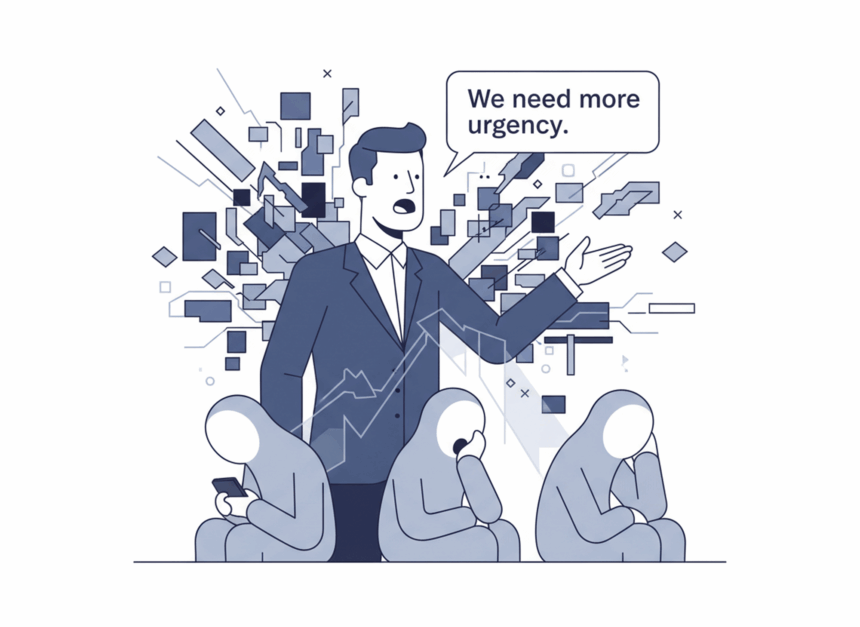
Organizations often repeat the same complaints:
“The frontline isn’t moving.”
“People don’t feel the urgency.”
But in many cases, the issue is not mindset.
It is structure.
Roles remain vague.
Responsibility and authority drift apart.
Actions stay invisible, and context is barely shared.
In this environment, telling people to “feel urgency” simply evaporates into the air.
Urgency does not emerge from pressure or motivational speeches.
It appears only when the structure allows it.
And this structure cannot be built overnight.
An organization’s history, evaluation systems, decision‑making habits,
and the flow of information—
these accumulated layers determine whether urgency can exist at all.
Organizations where urgency never emerges share common traits:
unclear roles, blurred accountability, fragmented information,
and a quiet belief that “someone else will handle it.”
As long as this atmosphere persists, the organization will not move.
In contrast, organizations where urgency arises naturally
have clear roles, aligned responsibility, visible actions,
and shared context.
The temperature gap between managers and the frontline is small,
and “what needs to be done” is structurally visible.
If your organization feels slow,
the issue is likely not awareness—
but a broken structure.
What kind of structure allows urgency to emerge?
And how is that structure built?
👉 The full article is available exclusively to Substack.
Read more here:
“Have a Sense of Urgency”… Yet the Managers Who Say It Are Often the Least Urgent