



Instructions Are Given, but No One Moves ─ The Moment Work Stalls
In meetings, managers often speak up and give directions. Yet those directions lack specificity, leaving employees unsure of what to do next. Words are spoken, but tangible results are absent, and the workplace stalls.
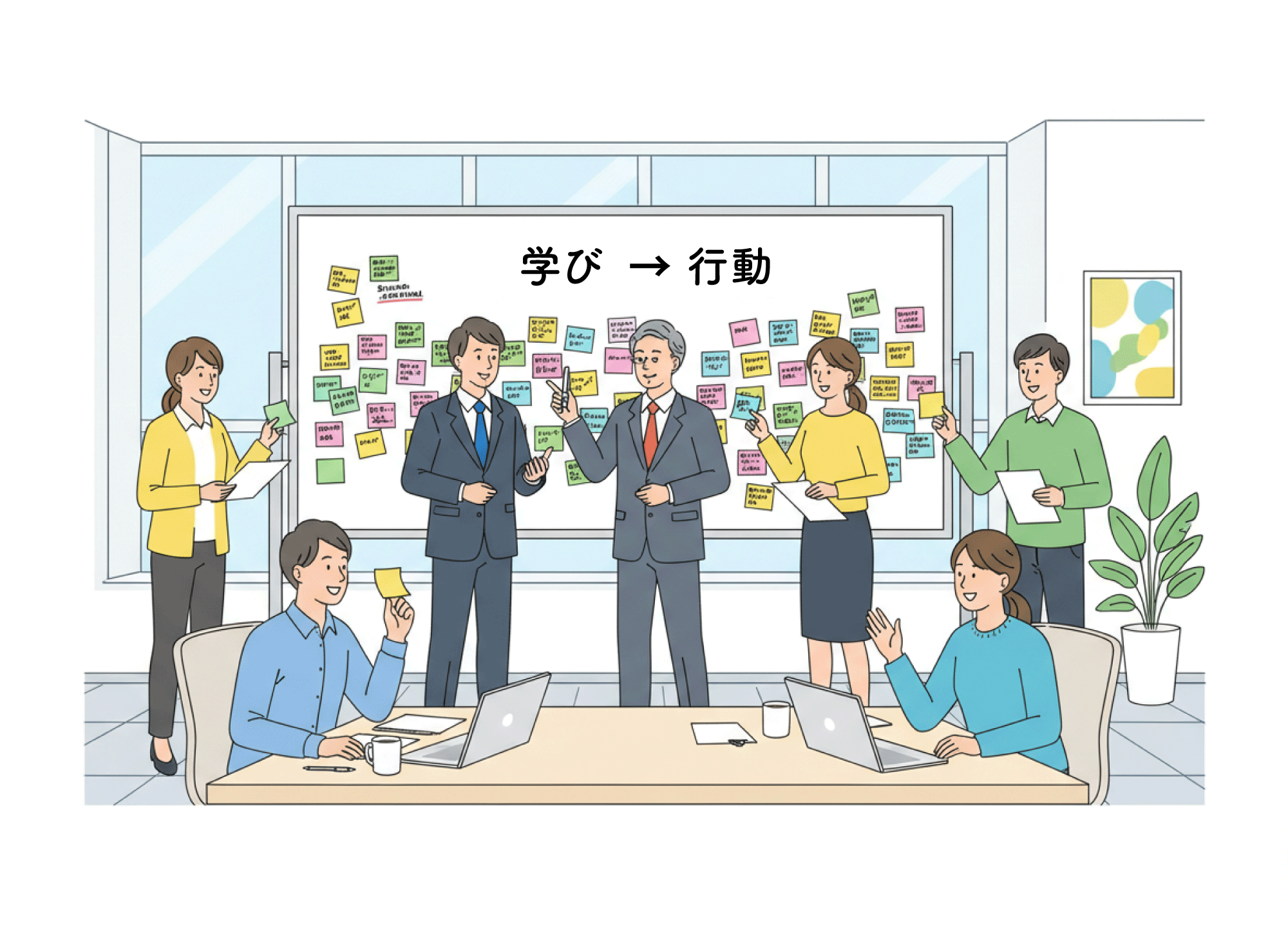
This is not always laziness. Many managers genuinely try to improve, but they struggle to translate what they have learned into concrete action. In such cases, repeating training or lectures rarely solves the problem. What works is embedding a system into the organization that ensures learning is always converted into action.
How Postwar Corporate Culture Produced “Learning-Only Managers”
The inability of managers to turn learning into action is rooted in Japan’s corporate culture from the Shōwa and Heisei eras.
At that time, proposals that deviated from precedent or challenged senior authority were rarely welcomed. Maintaining harmony was valued more than producing results. Managers were expected to “read the room” rather than deliver outcomes. As a result, they advanced in their careers without ever being required to demonstrate how learning could be applied in practice.
This culture produced a generation of managers who avoided responsibility, relied on abstract language, and lacked training in connecting learning to real work. Consequently, workplaces today still suffer from vague instructions, missing accountability, and recurring stagnation. The next chapter illustrates typical scenarios and how system design can resolve them.
Common Stagnation Scenarios and System-Based Solutions
One familiar scene is the meeting where a manager says, “Let’s review this later,” without clarifying what needs to be done. Employees are left confused, and time slips away. Embedding a system that requires every directive to be recorded with its purpose, expected outcome, deadline, and responsible person prevents such ambiguity.
Another common situation: meetings are lively, but once they end, no one knows who is responsible for what. Progress disappears until the next meeting. This can be solved by standardizing an “action log” and making progress review mandatory at the start of every subsequent meeting. Tasks no longer vanish into thin air.
A third scenario: new ideas surface but are quickly dismissed with “no precedent” or “too risky.” The proposal evaporates into the air. To counter this, organizations can institutionalize small-scale experiments—short-term, low-budget trials. Even if results are not successful, the attempt and the lessons learned are recorded and valued. This ensures that proposals lead to action rather than disappearing.
Embedding Action into Performance Evaluation
Instead of emphasizing the importance of learning through education, organizations should incorporate “learning turned into action” directly into performance evaluation. This can be achieved through HR evaluation sheets and 360-degree feedback.
- HR Evaluation Sheets
Add a section for “examples of learning applied to action.”- Example: Using knowledge from training to improve meeting materials
- Example: Applying insights from self-study to streamline workflows
→ Keep entries concise: action, result, impact.
- 360-Degree Feedback Questions
- Did this person’s learning benefit your work?
- Were their proposals concrete and actionable?
- Did their actions lead to the next step?
- Operational Flow
- Employees record actions linked to learning in a simple form (1–2 lines plus evidence).
- HR aggregates cases quarterly.
- Feedback confirms usefulness, concreteness, and executability.
- Results feed into promotion and compensation decisions.
Conclusion
Japan’s corporate culture in the Shōwa and Heisei eras institutionalized avoidance of risk and discouraged turning learning into action. While conservatism exists globally, in Japan it was particularly entrenched. The solution is not more education, but embedding systems into HR and organizational design that ensure learning is transformed into action.
What is required is not simply more knowledge, but the courage—and the structure—to act on it.