



Repeating Narratives Silence Questions
In regional companies and second-generation family businesses, I often hear the same phrases from executives:
“This is just how our company works.”
“This strategy will succeed.”
“I came up with this plan myself.”
These aren’t just habits of speech.
Repeated over time, they shape the organizational atmosphere.
And once that atmosphere settles, questions become harder to ask.
Strategies start to “descend from above.”
Teams begin searching for the “right answer.”
Asking questions becomes a risk.
Narratives grow stronger, while the reasoning behind decisions fades.
This is the distortion caused by narrative bias.
When Narratives Overgrow the Roots: What Is Narrative Bias?
People find comfort in coherent stories.
They feel safer following a narrative than questioning it.
But when narratives become too dominant, the logic behind decisions disappears.
Questions like “Why this strategy?” or “How was this decided?” get buried.
Research from Cambridge University shows that risk evaluation is heavily influenced by the strength of a narrative.
When narratives dominate, decisions rely on storytelling rather than evidence.
True decision-making should be grounded in structure and context:
- Market shifts
- Customer behavior
- Internal communication climate
- Transparency in decision processes
These coordinates help prevent decisions from being hijacked by narrative bias.
In Structures That Repel Questions, People Stop Growing
In narrative-heavy organizations, strategies are handed down.
There’s no space to question them.
Managers become mere messengers, losing the chance to develop judgment.
Young employees learn to read the room.
Avoiding disruption becomes a virtue.
They prioritize finding the “right answer” over forming their own thoughts.
Eventually, thinking itself becomes a risk.
In such structures, only those who echo the narrative rise.
Without experience in redesigning structure, titles increase—but substance doesn’t.
Narrative repetition becomes the organization’s moral compass.
Why Do Yes-Men Multiply? Because Pushing Back Doesn’t Work
In these environments, not only are questions repelled—they’re rendered meaningless.
“You can’t challenge the CEO’s narrative.”
“Strategies are just performance pieces.”
“Even if I ask, no one listens.”
This atmosphere breeds silence.
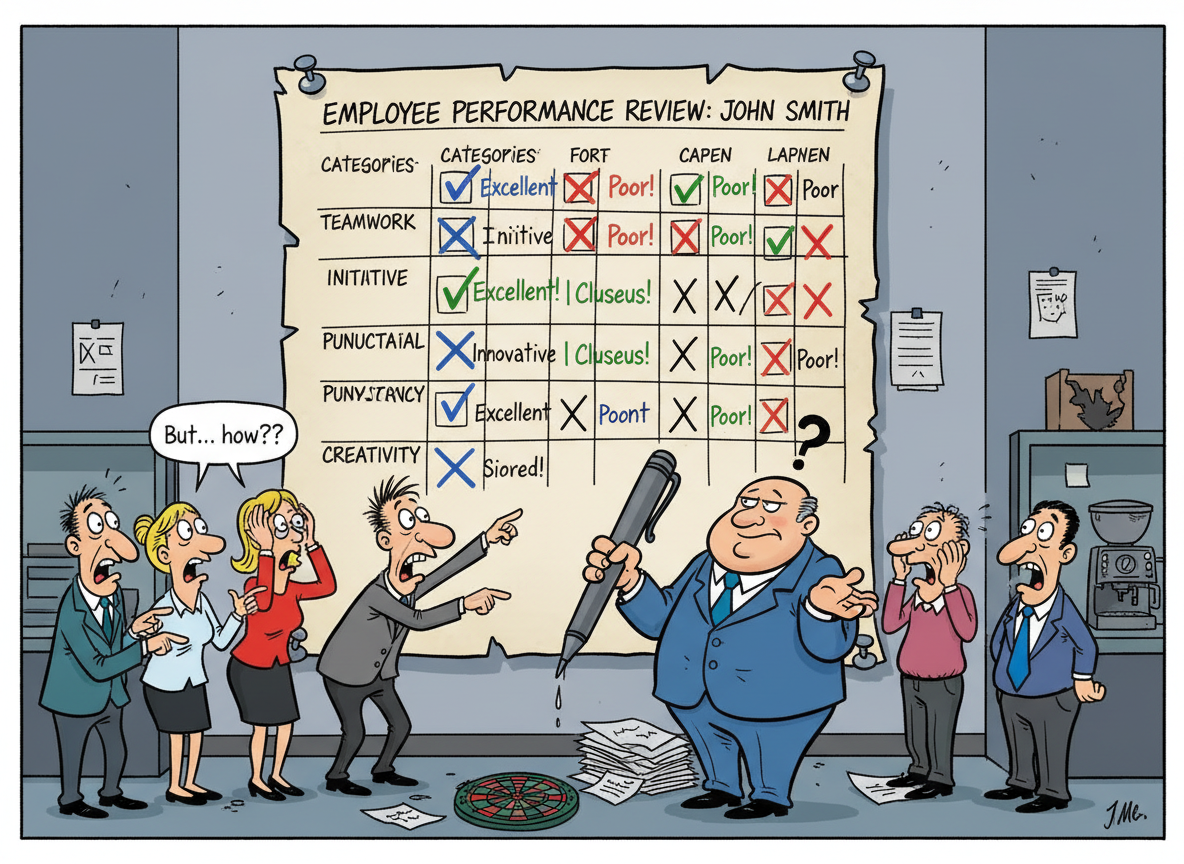
Only those who align with the narrative get promoted.
Those who question it are seen as “difficult.”
Eventually, questioning becomes a disadvantage.
And so, conformity becomes the only viable path.
Questions That Reveal the Gap Between Narrative and Structure
Consider these:
- “How was this strategy decided?”
- “Was the frontline consulted before this policy?”
- “Was this decision based on data, examples, or just experience?”
- “Is there space to ask, ‘Is this really true?’ in this company?”
- “Are managers thinkers—or just transmitters?”
These questions help uncover the hidden flow of decisions.
They arise naturally from all levels of the organization.
Questions as Light: How Hearing Illuminates Structure
In interviews, I always speak with both managers and new employees.
Because questions emerge from both ends.
Manager narratives contain embedded decision flows.
New employees’ discomfort reveals whether those flows connect to broader norms—or are isolated.
Discomfort signals a disconnect.
Tracing that discomfort reveals whether it stems from structural distortion or personal misunderstanding.
Questions are light from the outside.
When that light reaches in, the organization can finally see its own shape.
Narratives that once obscured structure begin to reveal contours.
And those contours become coordinates for redesign.
Can We Multiply Those Who Ask?
To ask is to reweave structure.
And that’s not just the role of management.
New employees’ discomfort, frontline voices—can they be received as questions?
That determines the future of the organization.
What roots are being covered by your organization’s repeated narratives?
Is there space to return questions to those narratives?
When we ask, we notice the gap.
But knowing how to move forward isn’t easy.
If you feel the need for support in redesigning structure, feel free to reach out.