



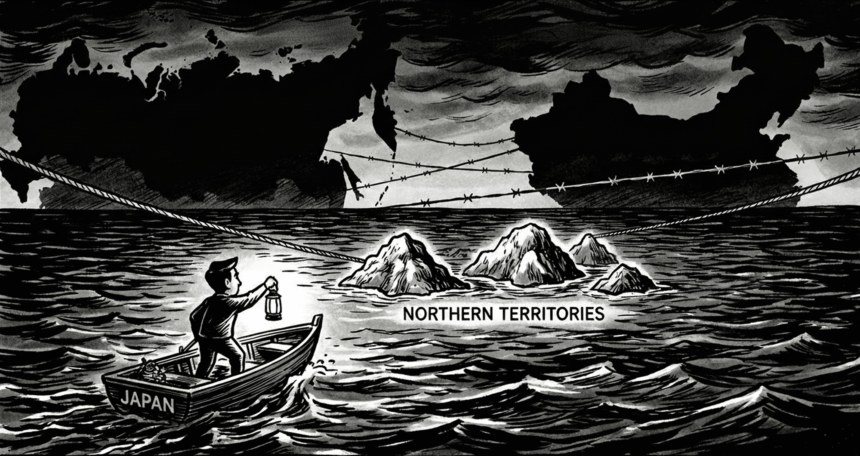
Japan, China, and Russia form a tense “geopolitical triangle” in Northeast Asia. With the United States deeply involved, the regional security environment becomes even more complex.
Japan is a U.S. ally, yet it cannot ignore its relationships with China and Russia. Depending on any single major power is no longer enough. Japan needs a more autonomous foreign policy.
In the postwar order, territorial sovereignty is determined by treaties, not by historical narratives. History can be interpreted in many ways and has often justified conflict. This is why the postwar system placed treaties at the center of territorial settlement. Today, the idea that the international community should not accept any forceful, unilateral change of the status quo has become increasingly emphasized.
This perspective is essential when considering the Northern Territories.
Russia and China both use history and geopolitics in diplomacy, but with different priorities. China often emphasizes historical narratives, while Russia tends to focus on security concerns such as buffer zones. These differences reflect distinct strategic logics that Japan must understand.
Japan, by contrast, is a maritime nation. Its energy and resources depend on sea‑borne trade, making the stability of sea lanes central to national security. Maritime states emphasize international cooperation, the rule of law, and freedom of navigation, while continental powers often prioritize border stability and influence over surrounding regions. This difference in strategic culture shapes the difficulty of the Northern Territories issue.
The Northern Territories remain legally unsettled. The Yalta Agreement lacked legal force, and the San Francisco Peace Treaty did not specify the islands’ recipient. This unresolved status suggests the issue is not only a territorial dispute but also a symbolic theme for rethinking Japan’s foreign policy.
Historically, Japanese, Russian, and Ainu communities once lived together in Etorofu and Kunashiri. Even today, cooperation is possible in areas such as fisheries, tourism, economic ties with Sakhalin, environmental protection, disaster response, and medical collaboration. These practical fields can serve as entry points for rebuilding trust.
The Northern Territories issue does not move first. It moves last.
This is why the sequence—where to begin and how to build upward—is the essence of diplomatic strategy.
By gradually building cooperation in practical areas, the overall structure of Japan–Russia relations can shift. Only then does the possibility of addressing the territorial issue emerge. The goal is not to redraw lines first, but to reshape the relationship itself.
👉 The full article is available exclusively to Medium.
Read more here:
Rethinking Japan’s Foreign Policy Through the Northern Territories