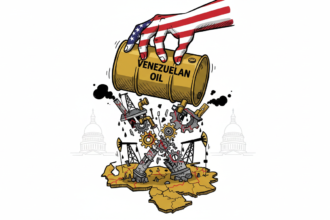




The United States is moving forward with the sale of seized Venezuelan oil, and debates over the strategic handling of Greenland have resurfaced in the Arctic.
At first glance, the U.S. appears to be shifting toward a more territorial posture — one that looks willing to acquire, control, or directly shape physical space.
Yet this direction is precisely where the problem lies.
The instinct to pursue territory, while intuitively appealing, is the furthest from how the United States has historically gained strength.
America did not rise by accumulating land.
In fact, territorial expansion has rarely aligned with the sources of American power.
The developments around Venezuela and Greenland should be read not as signs of renewed strength, but as indicators that the U.S. may be drifting away from the strategic advantages that once defined it.
America’s Power Has Never Been Territorial
The United States became influential not by enlarging its borders, but by controlling the circuits that connect the world.
Its military alliances, global network of bases, dollar-centered financial system, technological standards, and cultural influence have all functioned as non‑territorial levers of power.
These networks allowed the U.S. to shape global outcomes without the burdens of administering vast territories.
This model resembles the Roman Empire’s road system or the British Empire’s maritime routes — modernized into alliances, standards, and financial architecture.
America’s strength has always been rooted in connection, not land.
Territory Generates Costs That Do Not Scale with Distance
Territory looks attractive on a map.
But from the perspective of statecraft, territory is not an asset — it is a liability.
Administration, security, infrastructure, insurgency management, diplomatic friction, and supply lines all impose costs that grow non‑linearly with distance.
Empires rarely collapse because they lose wars; they collapse because the cost of maintaining territory exceeds their capacity to bear it.
Rome, Britain, and the Soviet Union all reached this breaking point.
Modern America is not exempt from the same structural pressures.
Territorial Expansion Is a Victory That Turns into a Trap
Strong leaders often equate territorial gain with national success.
Maps make expansion look like progress — clean, measurable, and emotionally satisfying.
But territorial expansion is also the trap adversaries most want the U.S. to fall into.
More territory means higher costs, weaker alliances, rising resentment, and fewer resources available for future‑oriented domains.
In this sense, territorial expansion does not strengthen the United States.
It dilutes its advantages and amplifies its vulnerabilities.
If you’re interested in how these structural dynamics evolve beyond territorial costs, the full continuation of this analysis is available on Medium.
👉The rest of the article (Chapters 4–Conclusion) is available on Medium.
Read more here:
The End of the Territorial Age: How Venezuela and Greenland Reveal the Temptation of Land