


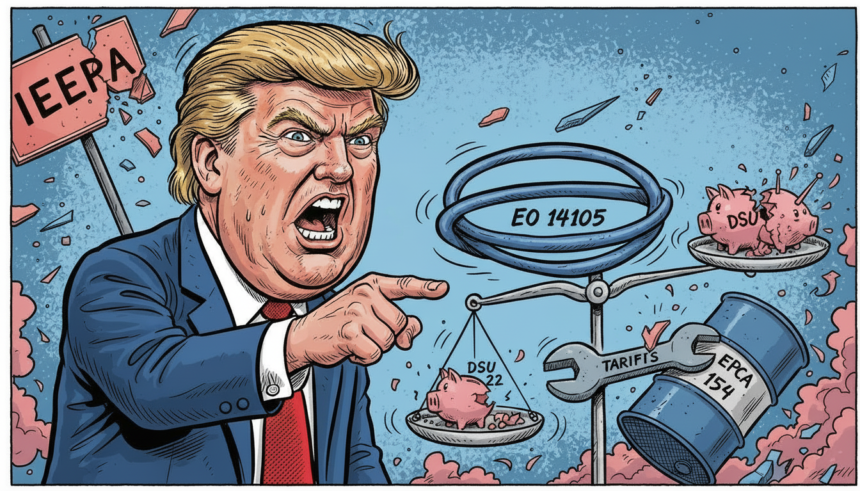
The U.S. Supreme Court recently ruled that the Trump administration’s blanket 10% tariff was unconstitutional. The issue was not the tariff itself, but the use of IEEPA—a statute never intended to authorize broad import duties—to impose it. Under the Constitution, taxing authority belongs to Congress, and presidential tariff powers exist only through specific statutes such as Section 232, Section 301, or Section 122. The ruling simply reaffirmed that boundary.
In the political arena, however, the ruling has taken on a different meaning. The Trump campaign is using it as narrative fuel, framing courts, bureaucrats, and the media as an invisible enemy. Even policy setbacks are recast as proof that entrenched interests are trying to stop him. U.S. politics is increasingly driven by narrative rather than institutional logic, and this decision reinforces that trend.
With IEEPA no longer usable, other statutory “numbers” have moved into focus. Section 122 allows up to 15% in temporary tariffs. While no universal 15% tariff has been decided, the number itself has begun to function as a political ceiling. The legal basis may ultimately come from Section 232 or 301, while the symbolic legitimacy comes from Section 122. This gap between legal context and political context is likely to reappear in future policy debates.
The ruling also highlights which institutional numbers the Trump team could reinterpret next. The Immigration and Nationality Act (INA 201–203) sets annual caps by country and category; reframing these caps could justify sharp cuts for specific countries, affecting labor supply and workforce planning. Executive Order 14105 and Treasury regulations define restricted sectors for outbound investment to China; expanding these sectors would signal a tougher stance and fragment technology supply chains. WTO DSU Article 22 sets the maximum level of retaliatory tariffs; invoking this ceiling as “maximum WTO‑approved retaliation” would raise costs for targeted industries. EPCA Section 154 sets the maximum Strategic Petroleum Reserve capacity; large‑scale stockpiling or releases could be used for political effect, creating short‑term volatility in oil markets.
What these statutes share is the presence of explicit numbers. Designed as policy limits, they can be repurposed as symbols of political strength. When these numbers move, the effects do not remain isolated. Immigration, labor, technology, trade, and energy systems shift together, quietly reshaping global supply and demand.
The United States’ internal tremors ripple outward. Yet within this instability lies strategic space for governments and companies. Understanding when an institutional number becomes a political number is becoming essential for navigating the emerging international environment.
👉 The full article is available exclusively to Medium.
Read more here:
The United States in Motion and the World’s Quiet Reordering